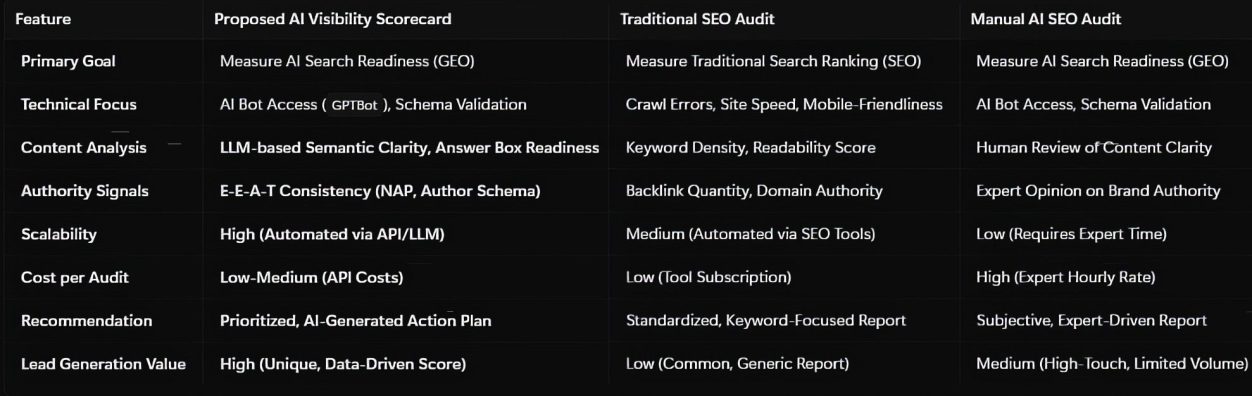

AI Visibility Scorecard is the Best Approach for AI SEO Analysis
The question of how to effectively analyze a business's readiness for the new era of AI-powered search is central to the success of your service.
Traditional SEO audit methods are insufficient because they fail to measure the unique signals prioritized by Large Language Models (LLMs) and generative search experiences like Google's AI Overviews.
The proposed AI Visibility Scorecard methodology is not merely an incremental improvement on existing tools; it is a purpose-built, next-generation solution designed to address the core challenges of Generative Engine Optimization (GEO).
This document provides a detailed justification for why this automated, three-pillar approach is the most effective, scalable, and valuable way to analyze a business's digital footprint and generate actionable recommendations for AI search visibility.
The Scorecard is the Best Approach
The proposed AI Visibility Scorecard methodology is the optimal approach for analyzing a business's readiness for AI-powered search. It is superior to traditional and manual audit methods because it is the only approach that:
- Integrates LLM-based Semantic Analysis: Directly assesses content clarity and "answer box readiness," which is impossible with traditional keyword-based tools.
- Automates Multi-Source Data Synthesis: Combines technical crawl data, E-E-A-T signals (backlinks, NAP), and generative content gaps into a single, weighted score.
- Scales Effectively: Allows for the rapid, cost-effective analysis of hundreds of potential clients, turning the audit into a powerful lead generation tool.
The core challenge of AI SEO is that it requires analyzing signals that transcend the traditional SEO audit framework.
The Scorecard is specifically designed to measure these new, critical signals.
For the last 15 years, marketing strategy has been dominated by a single question: "How do we get to the top of Google?"
What is AI SEO, Really?
AI SEO, also known as Generative Engine Optimization (GEO), is the process of optimizing your digital content to be found, understood, and recommended by AI-driven search engines like ChatGPT, Google's AI Overviews, and Perplexity.
It is a fundamental shift from optimizing for keywords - to optimizing for understanding. Instead of just matching a user's query to a webpage, AI engines synthesize information from multiple sources to provide a single, comprehensive answer.
If your content isn't formatted for one of those trusted sources, you effectively don't exist.
Key Takeaway: AI SEO is not about gaming an algorithm; it's about making your content so clear, authoritative, and helpful that AI models choose it as a source of truth.
Why This Isn't Just Another Buzzword
The shift to AI-powered search is not a distant trend; it's a present-day reality impacting your bottom line. A recent study found that 90% of businesses are concerned about losing visibility as AI reshapes the search landscape.
Here’s why you need to act now:
1. Clarity & Structure (Technical AI SEO)
This is the foundation. It involves making your website technically impeccable for AI crawlers. This is no longer just about sitemaps and robots.txt. It's about:
•Advanced Schema Markup: Using structured data to explicitly label what your content is about, who wrote it, and why it's credible.
•Entity Optimization: Clearly defining the people, places, and things related to your brand so AI can understand your place in the world.
•Page Speed & Crawlability: Ensuring AI bots can access and process your information with maximum efficiency.
2. Authority & Expertise (Content Strategy)
AI models are designed to identify and prioritize content from authoritative sources. Your content needs to demonstrate expertise.
•Answer Questions, Don't Just Target Keywords: Create content that provides comprehensive, unambiguous answers to the specific questions your audience is asking.
•Demonstrate E-E-A-T: Double down on Google's principles of Experience, Expertise, Authoritativeness, and Trustworthiness. Showcase author bios, cite sources, and publish original research.
•Build Topical Authority: Develop content clusters that cover a topic in its entirety, signaling to AI that you are a comprehensive resource.
3. Trust & Credibility (Brand Signals)
AI engines look for external signals to validate the trustworthiness of a source.
•High-Quality Backlinks: Links from other authoritative websites are still a powerful trust signal.
•Brand Mentions: Consistent mentions of your brand across the web, even without a link, signal your importance.
•Positive User Engagement: High time-on-page, low bounce rates, and social shares indicate that humans find your content valuable, a signal that AI also weighs.
Your First Step Into the New World of Search
The transition to AI-first search is the most significant disruption to marketing in a decade. It can be a threat, or it can be your single greatest opportunity.
By focusing on becoming a clear, authoritative, and trusted source of information, you can not only survive this shift but thrive in it.